Too big, too small, or just right? The benefits of neighbourhood scale energy and water management
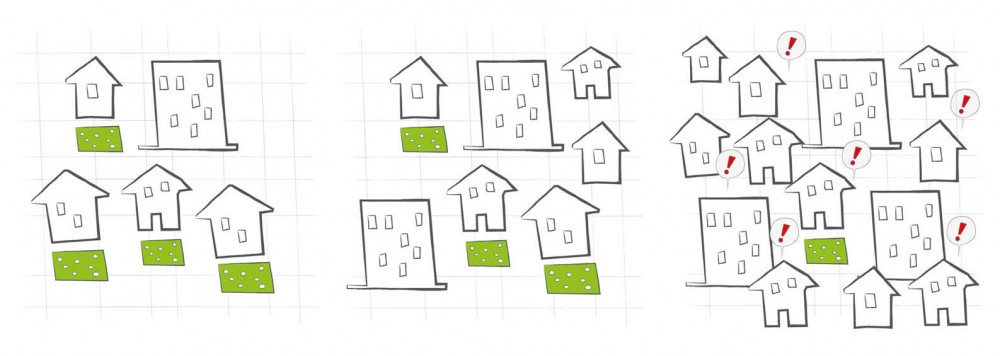
If only cities didn’t grow. Or shrink. If they just stayed the same size, engineers would be delighted. We could optimise the system, balance everything perfectly, and ensure everything performs as it was designed. This was probably the idea when we first built our centralised energy and water systems for cities. Big populations served by big infrastructure. But we never could have anticipated how much populations would grow, urban areas would re-shape and how much pressure we would put on our resources.
Arguably, we are now stuck with some pretty clunky systems that have been gradually expanded and patched up to cope with these changes. Our electricity is generated far outside cities and towns and transported large distances along transmission networks that require significant ongoing investment to maintain and upgrade to meet our changing needs. What’s worse, that extensive distribution results in energy losses and unnecessary carbon emissions. Furthermore, the coal and gas power plants that supply them are happily pumping out heat energy for only the atmosphere to enjoy because there are no potential users of heat within miles of the plants. Our centralised water systems have suffered a similar fate, using large amounts of energy to distribute water from rural reservoirs to every property across the city, leaking some of it along the way, before then going to the trouble of collecting all the used water up again in sewers and sending it on another long journey for treatment and disposal.
It’s true that you will see economies of scale for large systems on paper, but the problem is that centralised systems don’t easily respond to local context, which in our world is ever-changing. So, why not do everything at the building scale? Photovoltaics on roofs, rainwater tanks for every home. Sure it works, but probably works best in lower density areas and where building owners can closely manage their own systems, and it can be pricey. In denser urban precincts, the physical and the social dynamics are more complex and it’s here that a happy medium can sometimes be found. Enjoying both an economy of scale, and an ability to tailor design to respond to local needs and resources, precinct or neighbourhood-scale systems are enjoying the best of both worlds.
District energy systems, which generate electricity locally to minimise transmission losses and can also capture precious heat energy for local use, have gained interest in the major Australian cities. District-scale cooling has recently been explored for both Sydney CBD and Brisbane CBD. Unsurprisingly, energy demand follows people – it’s high in homes in the morning and at night, and when we head to work during the day, demand peaks in our office buildings and workplaces. So by linking an energy system across different building types, we can create a more efficient and balanced energy system. The challenge comes in setting up a dedicated operator of a local system. Historically, we have mainly helped university and hospital campuses in delivering these systems for that reason, but more and more we are working with dedicated energy service companies who will own and operate local systems for a neighbourhood using new funding models.
Water also finds some interesting synergies at a precinct scale. Looking just at a building, there is only a limited roof area to capture water, and only a limited number of people to use it. Looking outside a single building, the potential sources and users of water increase substantially – taking in roads, gardens, sports grounds, and of course other buildings. A precinct scale stormwater harvesting system or a local recycled water plant can enjoy an economy of scale, while tailoring its operation to local users. Our recent work in a mixed-use redevelopment area in northern Melbourne followed a district energy funding model to demonstrate that a gradually expanding precinct stormwater harvesting scheme for both irrigation and building based uses would achieve water management targets at a much lower cost than lot-based systems, while also providing flexibility to grow the system slowly in sync with development.
In a future where precinct-scale utilities become more commonplace, we think there will be even more potential to gain mutual benefits across energy and water systems, by sharing infrastructure portals, providing local water for use in energy generation and vice versa, and exploring using wastewater biogas as part of the energy portfolio. By thinking bigger in a smaller area, there is a lot more to discover.
~ Celeste Morgan + Toby Roxburgh, E2Designlab